

NeoCon & Design Days Through a Biophilic Lens
Stepping into the world’s leading annual trade show for the commercial interior design industry, is a wildly overwhelming sensory experience.
Every showroom or booth competes for your attention.
Crowds pack the hallways, the noise level is at 100%, and just finding your way around takes a lot of effort.
But I navigated all of it with one goal: to find out how biophilic design was showing up.
Turns out, there is a lot to discuss, so I’m turning my reflections into a four-part blog series:
- Part 1: Evaluation Criteria (the methodology around how I rated what I saw)
- Part 2: Direct Nature Connection (the actual physical presence of natural, living elements)
- Part 3: Indirect Nature (representations of natural elements like a wood table or organic shapes)
- Part 4: Space & Place (the way we understand and move through spaces)
As I write Parts 1, 2, and 3, I’ll include links here.
But first, I’ll share some context for those unfamiliar with NeoCon.

What are NeoCon and Design Days?
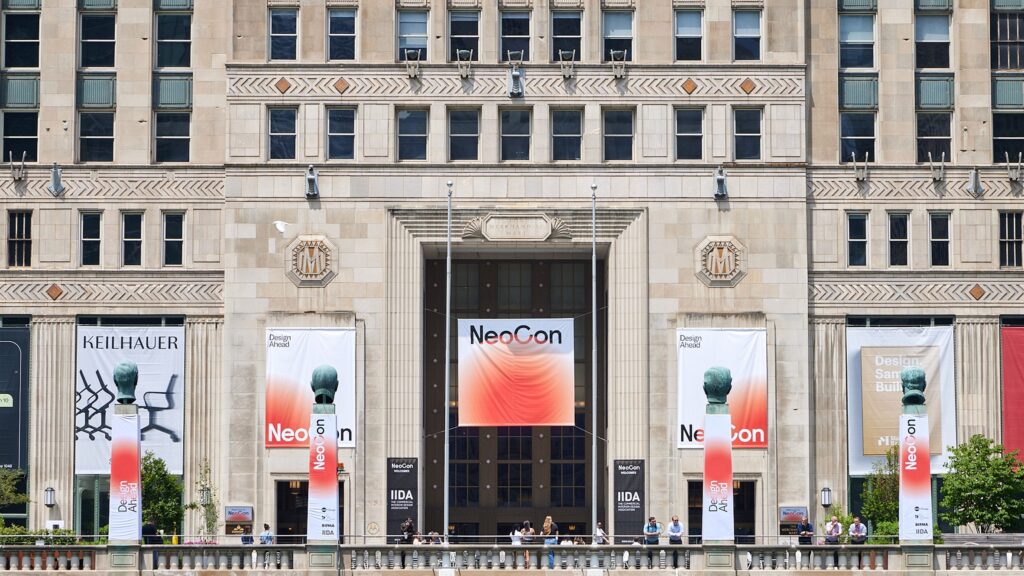
NeoCon is held every June in Chicago at The Mart (formerly the Merchandise Mart), and serves as the premier launchpad for new furniture, textiles, and lighting for workplaces, healthcare facilities, and educational spaces.
To give you an idea of the scale, the showrooms span over 1 million square feet of exhibition space with 450+ leading brands and over 55,000 attendees.
But even that wasn’t enough to hold all the industry had to offer!
So in 2023, Design Days was introduced and ran in tandem with NeoCon.
Located in Fulton Market (about a mile from The Mart), Design Days brings a fresh approach to the show. It hosts approximately 80 additional showrooms, spaced out in various buildings over 10+ city blocks.
How I Established My Evaluation Criteria
While I was able to visit both sites, I had just under two days to see as much as I could. I was not able to visit every showroom, evaluate every trend, or talk to all the manufacturer reps to understand their intent.
But I did walk as many hallways as I could – scanning what was easily accessible, entering showrooms that caught my eye and chatting with as many reps as possible.
I paid close attention to the showrooms, furniture, finishes, lighting, and marketing.
I took a lot of images, and tried to make notes on my experience as I progressed. Then I sat down with my photos and notes and went through them one by one.
What follows is a starting point for a broader conversation about how biophilic design is showing up in commercial interiors.
Step 1: Identifying What Counts as Biophilic
Before I could evaluate anything, I needed parameters for what I’d even consider “biophilic design.
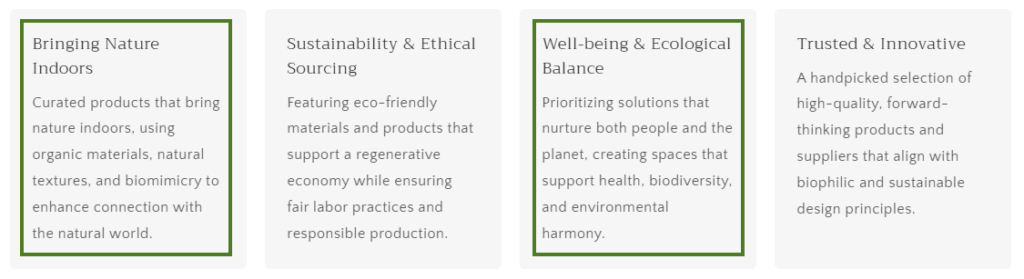
Since I knew my time and perspectives would be limited, I decided to use the Biophilic Design Sourcing Hub as the start of my evaluation criteria.
The Sourcing Hub has developed a rating system that evaluates products and brands on how well they align with biophilic design principles. It looks at things like natural materials, natural patterns and forms, support for biodiversity, and environmental impact.
I love this system and highly recommend checking out their site!
While ALL of the aspects in this system are critical to good biophilic design, I was focused on two aspects: Bringing Nature Indoors and Well-being & Ecological Balance.
Then, I needed to decide how I would analyze the space.
I knew I had two options:
- Do I look at the space holistically, like we really experience it?
- Or do I analyze how each biophilic element was used?
I chose to go with the latter because it gave me more precision for a blog format, even though experiencing a space holistically is still the truest test.
Step 2: Evaluating the Application as a Whole
With those parameters in place, I rated products and spaces through two critical lenses:
Lens 1. The Frameworks: Are there biophilic design “ingredients” present?
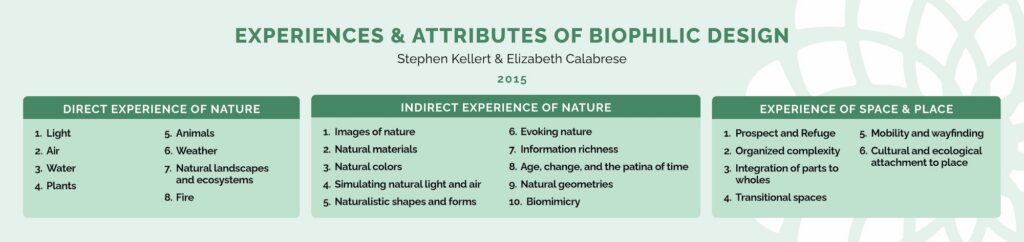
To answer that question, I used the Stephen Kellert & Elizabeth Calabrese’s framework: Experiences & Attributes of Biophilic Design.
If you are familiar with biophilic design, it’s likely you’ve come across two other framework options:
- Terrapin Bright Green’s 14+ Patterns and
- Stephen Kellert’s earlier framework, Elements and Attributes of Biophilic Design, which is used by International Living Future Institute.
Frameworks are simply different ways of organizing a system of thinking about a topic.
All of these frameworks are beneficial, but I chose Experiences & Attributes of Biophilic Design because it felt the most comprehensive while also being the clearest to understand and the easiest to apply.
I like to think of the elements listed in the framework as the ingredients – the individual aspects of a space.
These are things like plants, natural materials, biomorphic forms, prospect and refuge, mystery, connection to nature, sunlight, etc.
These are the ingredients of Direct Experience with Nature:
- Plants
- Light
- Air
- Water
- Animals
- Weather
- Natural landscapes and ecosystem
- Fire (Kellert/Calabrese)


But having all the right ingredients doesn’t guarantee a good cake. If they aren’t combined in the right way, you can end up with something that looks good on the outside but doesn’t taste very good once you take a bite.
The same is true for biophilic design.
A plant in a corner checks a box (it’s one individual ingredient).
But a plant that’s integrated into the space, that you feel as you brush past, that you smell, that changes over time – is doing so much more.
It becomes an integral part of the recipe.
To determine if biophilic design was put together in a truly biophilic way, I am once again turning to Stephen Kellert & Elizabeth Calabrese and using The Principles & Benefits of Biophilic Design.
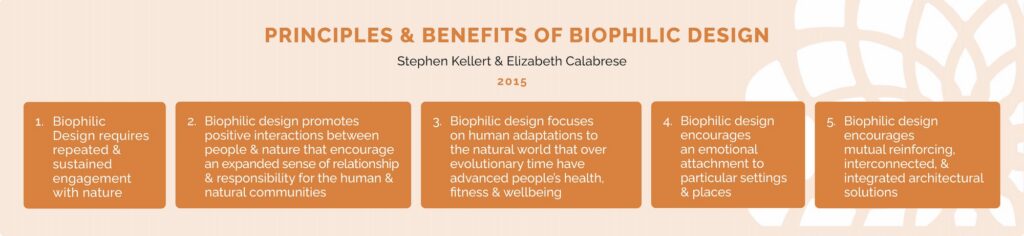
I turned their principles into questions that made it easier for me to use in an evaluation:
- Does it invite repeated and sustained engagement with nature?
- Does it promote positive interactions between people and nature that encourage a deeper sense of relationship and responsibility with the natural world?
- Does it support human health and well-being in ways connected to our evolutionary relationship with nature?
- Does it encourage emotional attachment to a specific setting or place?
- Does it feel integrated into the overall design rather than added on as a separate add-on?
My Rating System: How “Well” Did Biophilic Design Show Up at NeoCon and Design Days?
In this case “well” is determined by how meaningfully the principle is expressed through the experience, not just technically present, i.e. the cake was baked to perfection vs. thrown together in a bowl and dumped into a pan to bake.
Presence alone is not enough. True biophilic design supports sustained engagement.
Even if a moss wall or water feature is present, that alone doesn’t mean it supports sustained engagement, relationship, well-being, emotional attachment, or an integrated design solution.
So for each element I observed, I rated it against those five principle questions — not just whether it was there, but whether it was actually working.
⭐️ Ok: Ingredient present, but does not meaningfully exemplify the principles
⭐️ ⭐️ Good: Meets 1–2 principles well
⭐️ ⭐️ ⭐️ Better: Meets 3–4 principles well
⭐️ ⭐️ ⭐️ ⭐️ Best: Meets all 5 principles well
I’m not going to call out a manufacturer unless I really love what they did.
My goal here is to educate, not to shame anyone.
I’m genuinely thrilled when I see an attempt made, and based on the research, an OK is still better than nothing! (Plus, it takes a lot for me to score a project as a 5!)
What’s Next:
Many of these spaces are looking at workplace wellbeing, office design for productivity, healthcare environments, classroom design.
Coming next in Part 1 – Direct Experience of Nature at NeoCon & Design Days? How did the natural elements show up?